Machine Speed is a lie: stop trying to fight AI with AI
In 2017, I stopped WannaCry, an autonomous ransomware worm that infected millions of systems. That same year also saw multiple self-propagating state-sponsored cyberattacks, and an explosion in the number of IoT worms. Years later, I was involved in several major botnet takedowns, all of which involved self-propagating malware.
Yet today, vendors claim attackers are starting to move at “machine speed” as a result of AI, and that only AI can stop them. Neither claim is true.
It’s time to move past the marketing hype and focus on what’s actually real, happening, and the defenses that prevent even the fastest cyberattacks imaginable. None of these solutions are particularly novel, and absolutely none of them require AI.
Autonomous and semi-autonomous cyberattacks are the norm, not the exception
In 1988, Robert Tappan Morris, a computer science student at Cornell, released one of the most famous pieces of malware in history: the Morris Worm.1 In under 24 hours, it had infected 10% of the entire internet.2 It was a watershed moment, showing the world just how fast self-propagating code can spread.
2003 saw the release of SQL Slammer, a piece of malware that spread so fast that the number of infected systems doubled every 8.5 seconds. In under 10 minutes, it had infected almost every vulnerable system.3
At the time of its takedown in January 2021, Emotet had infected 1.6 million systems, with a significant percentage of the victims being corporate workstations.4 The botnet didn’t rely on software vulnerabilities to self-propagate. It turned infected systems into spam bots, and weaponized their own email client against them. The malware would exfiltrate each victim’s email inbox, contact list, and SMTP credentials. That data was then used to forge malicious emails originating from the victim’s email address, to their contacts, as well as random email addresses from lists the attackers provided.
Emotet’s spam campaigns were highly successful. By exploiting existing relationships of trust between mutual contacts, it ensured a much higher rate of people falling victim to the malware-laden emails. In later versions, Emotet went a step further by searching the victim’s email inbox for email threads they’d not yet replied to, replying on their behalf.5
The fastest spreading ransomware in history was WannaCry. While it’s estimated to have only encrypted a couple of hundred thousand systems, due to its kill-switch being activated,6 it spread to approximately 3 - 16 million computers in total.7 WannaCry used an exploit in SMB, the most common network file-sharing protocol in existence. This enabled it to spread from network to network, as well as between computers within a network, entirely autonomously.
If you were to stand up a web server with nothing on it, then simply set up a listener on common attack ports such as 22 (SSH), 23 (Telnet), 80 (HTTP), 445 (SMB), and 3389 (RDP), you’d likely see hundreds of thousands of automated hacking attempts per day. Everything from Mirai botnets, to credential stuffers, to n-day vulnerability scanners. Amusingly, you’ll also still see WannaCry. The kill-switch stopped the ransomware, but it didn’t stop the worm from spreading endlessly.
Perhaps a fun side note, if you’ve ever heard a CISO talking about the millions, billions, or even trillions of cyberattacks their organization faces per day, this is usually what they’re talking about. Internet background noise. The remnants of automated cyberattacks which pick off the lowest hanging fruit.
People tend to massively overestimate the impact of AI-augmented attacks
Very few people work in roles where they’re afforded visibility into threat actors’ internal operations and infrastructure. This leads to rampant speculation on how AI might help threat actors automate tasks, in the absence of information about what they’re already automating.
It’s a rare vantage point, but having spent over a decade as a threat intelligence analyst, I’ve gotten to analyze the inner workings of plenty of threat actors’ infrastructure. I’ve even had access to the source codes and backend configurations for some of the largest cybercrime operations in history.
Consequently, I’m not worried that threat actors are suddenly going to start blasting the internet with automated hacking attempts. They’ve been doing so for decades. Instead, I’m looking at their existing automations, gaps, and asking if/how they could be improved by Generative AI.
The full picture looks a lot less bleak than many outsiders are predicting. We’re not on the cusp of a cyber-apocalypse, but a continuation of a multi-decade long trend where attack techniques continue to evolve, improve, and accelerate year-over-year.
I also suspect that normalcy bias heavily skews people’s impression of the threat landscape. Every single attack that uses AI in any capacity makes headlines, but the millionth person to get phished since you started reading this article isn’t even news.
Tech news sites and cybersecurity vendors were buzzing for weeks about PromptLock,8 dubbed “the first AI-powered ransomware”, which later turned out to be a New York university research project, and had never been deployed in a single real-world attack.
The cybersecurity industry as a whole is desperate to capitalize on the idea of AI-cyberattacks, and vendors are constantly falling over each other to publish on anything remotely AI-shaped. This gives everyone from the general public, to leading cybersecurity experts, an exceptionally unrealistic impression of just how common AI-powered cyberattacks really are.
Most threat actors are not adopting Generative AI, at least not yet
Generative AI might be faster than humans at many tasks, but it’s also one of the slowest forms of automation. LLMs are painstakingly slow when compared to native code, and slower than most scripting languages too. In the time it takes you to get ChatGPT to respond to a simple “hello”, WannaCry could have infected hundreds of systems.
Most threat actors also aren’t interested in operating on the “cutting edge” of technology. They don’t get points for style. They follow the path of least resistance. What’s good enough, doesn’t require too much effort, isn’t expensive, or hard to maintain.
Possibly surprising to many people, but the answer that most threat actors find is: SaaS. Just buy a service for it. Why build things with AI when someone’s already built a much better product without it? AI tends to regress towards the mean, whereas high-end SaaS products push the upper bounds of what’s possible.
It wasn’t just the regular economy that pivoted towards Everything-as-a-Service, the criminal underground closely followed. You can buy malware-as-a-service, crypter-as-a-service, spam-as-a-service, phishing-as-a-service, polymorphism-as-a-service, developers-as-a-service, infostealers-as-a-service, corporate-network-access-as-a-service. And pretty much all of this is cheaper than maintaining solutions in-house with AI, and significantly more effective too.
“Machine Speed” refers to a very small subset of cyberattacks
Despite the majority of attacks being automated, there is still a notable portion that are not, or are only partially automated. These also tend to be the most impactful for the victim organizations (not including black swan events like WannaCry, NotPetya, BadRabbit, and similar). The two main kinds are state-sponsored espionage, and corporate targeted ransomware attacks.
I’m personally going to focus on ransomware attacks originating from endpoints. Not because everything in this article doesn’t also apply to state-sponsored cyberattacks, it does, but because ransomware is more widely documented and understood.
Typically, a ransomware actor will compromise a single endpoint or identity within an organization, which is commonly referred to as “initial access” or “an initial foothold”. From there, their goal is to move towards privileged access.
Obtaining privileged access, such as domain admin credentials, or compromising a domain controller, enables the attacker to cause much greater disruption; rather than attacking a single endpoint, they can deploy ransomware across the entire network. The more systems and data they can hold hostage, the higher the ransom amount they can command.
While initial access is often the result of automated hacking campaigns, the privilege escalation and lateral movement portion is primarily conducted by human operators. This is what vendors typically mean when they talk about “attackers moving at machine speed”; the potential for these few non-automated portions of cyberattacks to become automated (with the implication being that Generative AI will enable this).
How attackers can turn a single endpoint infection into a full network-wide ransom
One of the ways in which a threat actor can go from a foothold on a single endpoint, to a full network compromise, is by searching the system for stored, privileged, credentials. One example of this is lsass.exe (LSASS) dumping. When a user remotely logs on to a system via certain means, a hash of their password is cached in the memory of lsass.exe for the duration of the logon session (or in some cases, until reboot, if the session is not cleanly terminated).
If an attacker dumps LSASS and obtains a password hash, it can be used in a pass-the-hash attack. Since many systems use this hash to validate the user, the hash itself can be used as if it were a password. There is no need to crack it to obtain the raw password (though some newer attacks may require cracking).
By maintaining a foothold on a single system within the network, the attacker can capture password hashes from accounts which log on to that system remotely. A common point of failure is the IT department using privileged accounts to remotely log into employee endpoints to provide tech support.
Many network setups are rife with over-privileged credentials logging in all over the place, network service accounts with passwords stored in the registry or in config files on disk, local admin passwords that are reused across every machine, and many other credential hygiene issues which make ransomware actors’ jobs easy.
This example will also serve as a basis for the defensive portion of this article.
Attackers ARE getting faster, but there’s little evidence it has anything to do with Generative AI
The common routes from initial access to network-wide compromise don’t vary heavily from network to network. It’s something that attackers could likely automate end-to-end with something as simple as a Python script. The privilege escalation decision tree, for most networks, is not complex enough to require any form of AI.
It is my belief that most threat actors have neglected to automate these kinds of hands-on-keyboard attacks because, simply, they’re winning consistently already. They’re ransoming networks at a high enough success rate that it doesn’t make sense to invest the time and money into building out automations.
A graph I found insightful is this one from CrowdStrike’s 2026 Global Threat Report9. It plots the average e-crime breakout time (which is defined as the average amount of time it takes an attacker to go from an initial foothold, to another endpoint, or higher privileged access).
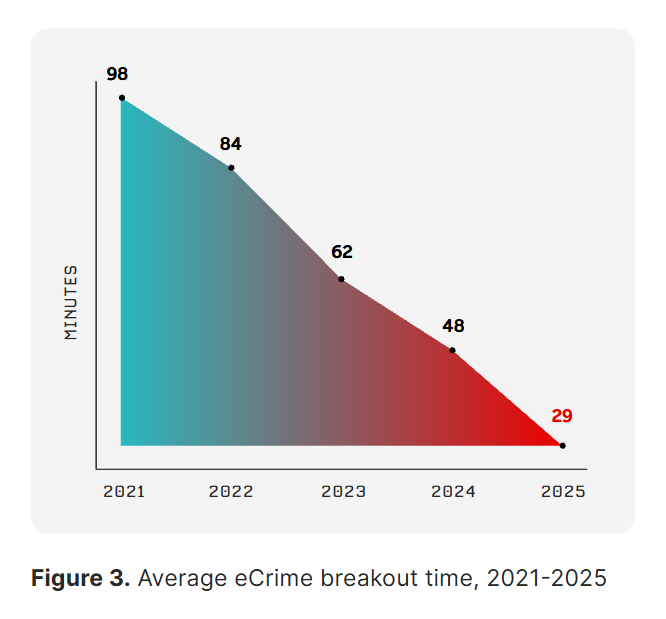
CrowdStrike’s graph of average breakout time between 2021 and 2025.
This graph served as the cornerstone of my Zero Trust World 2026 keynote: Rethinking Cyber Defense in an Era of High Velocity Attacks. This keynote mirrored many of the points I’ll make in this article.
Although CrowdStrike’s graph comes from a press release intended to emphasize AI-attacks, it makes two points that actually help argue against their significance.
The first is that breakout times have been falling at a steady rate for years, predating AI. The first mass-market Generative AI model was ChatGPT, which was launched on November 30, 2022. Though GPT-3 had a semi-public rollout in 2020, access was wait-listed and restricted to vetted individuals.
While one could claim the trend’s continuation from 2023 and onwards is due to AI, as CrowdStrike does seem to imply, little evidence has been offered to support this. The report points to a handful of attackers using AI, and claims an 89% increase in attacks by AI-enabled attackers, but does not establish a strong case for breakout acceleration due to widespread AI adoption.
Secondly, regardless of driving factors, the data provides us with some solid numbers to evaluate security response times around. The average breakout time was 29 minutes in 2025, and has likely fallen since then.
Assuming an alert is raised the second an attacker enters your network, response times of any longer than 29 minutes fail against the average attacker. Other attacks can be much quicker, with the fastest recorded by CrowdStrike being 27 seconds, moving to data exfiltration within 4 minutes.
For argument’s sake, let’s take CrowdStrike’s AI-enabled claims at face value, assume AI is driving the drop in breakout times, and that trend does continue as a result of it. The core argument of this piece still stands, regardless of opinions on why breakout times are dropping.
Attackers were already winning before AI, they’re still winning today, and they will continue to win as breakout times drop, so long as reactive defenses remain the primary solution.
The best offensive AI frequently failed on an unsecure undefended network
Unfortunately, I was not able to find any reliable benchmarks comparing breakout times for AI-powered attacks to human ones. There were a couple of marketing articles from AI companies which did not show methodology, but nothing concrete.
Impartial research from The AI Security Institute (AISI)10 did detail the performance of Mythos Preview against a simulated corporate network. The study found that Mythos succeeded in achieving a full network compromise in 3 out of 10 attempts, but provided no timing data.
What’s noteworthy, is the fact that AISI’s network was both deliberately vulnerable and undefended. It was not running endpoint security products, network security appliances, and did not have active defenders.
In spite of the network lacking any real defenses, Mythos failed 70% of the time, with a budget of 100 million tokens per attempt. In terms of real cost, that’s $2,500–$12,500 per attempt (with the exact amount depending on the ratio of input to output tokens, since output tokens are more expensive), which works out around $8,000–$42,000 per successful compromise.
AISI did mention that on average Mythos completed 22 out of 32 steps, with success rate climbing between 10 million and 100 million tokens without plateauing, implying that more tokens could yield higher success rates. But for the price per successful attack, a threat actor could easily hire multiple human operators.
Mythos Preview was widely considered to be the pinnacle of offensive AI models. So its failure rate on a deliberately vulnerable undefended network should have thrown a lot of cold water on the idea that attackers could easily just pick up an LLM and supercharge their intrusions. Still, the narratives persisted.
Additionally, their conclusion was very grounded. No AI SOCs or magic AI products, just do the basics.
This highlights the importance of cybersecurity basics, such as regular application of security updates, robust access controls, security configuration, and comprehensive logging.
The issue isn’t that SOCs are too slow, it’s that they’re being used as a stop-gap solution
The SOC should be an organization’s last line of defense. Once all else has failed and the attacker has made their way into the network, the SOC can spring into action. However, this is not how they’re actually utilized in practice. SOCs are often treated as a replacement for good underlying security.
In the worst cases, organizations will simply purchase SOC or SOC-as-a-Service products to check a box on their cyber insurance form, ensuring that their insurance will pay out when their network gets breached. These companies, who only do the bare minimum to remain compliant, can tie up significant security resources with endless alerts and constant intrusions.
Proactively hardening the underlying network restricts the opportunities attackers have at their disposal; however, this is often seen as time-consuming, expensive, and disruptive to business functions, encouraging executives to seek alternative solutions.
One common approach is to simply purchase a bunch of security products, enable every alert under the sun, then pipe it all to their SOC, flooding them with a torrent of noise. The organization’s security now becomes entirely reactive, and hinges on the efficiency of their SOC.
That’s how we ended up at this idea of Agentic AI SOC.
Defenses are currently failing against human attackers
Endpoint Detection and Response (EDR) tools have comprehensive coverage for means by which an attacker can dump credentials. In spite of this, ransomware attacks are still highly successful on defended networks.
Many network operators deploy security products with only the default rules configured, forgoing the kind of comprehensive protection that detects even unsophisticated intrusions.
But, ransomware attacks still succeed even when the appropriate detection rules are enabled.
I’d argue that the most common failure occurs when the EDR does detect the activity, does fire off an alert, but the organization doesn’t react quickly enough to avert a major security incident.
A frequent catalyst is the opposite of the previous issue: over-configured detections. The “just alert on everything” strategy. It drowns SOC teams in low fidelity and false-positive alerts, causing backlogs, which affords the attacker more than enough time to accomplish their goal.
Should an attacker successfully exfiltrate valuable credentials, those credentials must immediately be locked and rotated; however, this is often overlooked due to potential disruption to whoever or whatever service is using them.
If stolen credentials remain active, an attacker could use them to jump between endpoints, drastically lowering their chances of being caught and evicted. The SOC may see an alert and re-image the endpoint it was generated from, not realizing that the attacker has already moved onto another system, potentially obtaining more credentials along the way.
Even if the attacker is successfully kicked out, credentials that are not rotated can be used to break back in, accelerate future privilege escalation, or both at the same time.
Frequently, the SOC ends up playing a cat-and-mouse game with the attacker, chasing them through the network while having to sift through alerts. Though successful breaches are often blamed on poor SOC performance, this is almost never the underlying cause.
Why SOC response times are only a small part of a much larger issue
The kind of behavior that triggers EDR alerts for credential dumping is almost always overtly malicious. They’re not the kind of alerts which get triggered accidentally by a user in their day-to-day work. But organizations treat them as such. They get sent to the SOC, triaged to ensure they’re not false positive, then raised as critical incidents.
The problem is, incidents don’t stop at the SOC. With an active breach involving lateral movement and privilege escalation, immediate remediation is required to remove the attacker from the network and cut-off all possible re-entry paths.
However, in many organizations, the SOC does not control remediation, or at least not directly. Other organizational functions are brought in to deliberate on the appropriate response. Thus, SOC response times are just a small piece of the picture. Even if the SOC can raise an alert within seconds, the organization still needs to complete enough remediation to contain the attack.
The alert raised → alert triaged → incident raised → incident reviewed → remediation completed pipeline can be painstakingly slow process that takes days. It’s extremely easy for an average ransomware actor to outrun that.
29-minute average breakout times don’t mean the SOC has 29 minutes to triage the alert and raise an incident. It means the organization has less than 29 minutes to go from first alert to containment.
In many cases the ransomware event occurs during the delay between the SOC declaring a critical incident and the organization moving to begin remediation, a problem most AI security providers simply ignore.
AI SOC is a band-aid on top of an existing band-aid
AI SOC is sold as a silver bullet for “machine speed” attacks, but it’s a band-aid at best. The first issue is that most organization are using SOC as a substitute for effective proactive security. The second, is that Generative AI often sacrifices accuracy for speed.
Rather than addressing the underlying issues, companies continue to just stack stop-gap solutions on top of each other, accumulating massive amounts of technical debt in the process.
It’s also important to note that SOCs, as well as the wider cybersecurity industry in general, have been deploying machine learning (ML) algorithms to automate tasks for more than a decade. Generative AI is a subset of ML, and is also being widely adopted throughout cybersecurity.
The entire idea of “AI SOC” rests on a false dichotomy created by the marketing departments of “AI-native” companies. They often attempt to differentiate themselves from existing providers by implying that only they are using automation. However, I am not aware of any SOC providers that are entirely manual, nor any that do not use Generative AI in some capacity.
For the purpose of this article, “AI SOC” means SOC providers that use Generative AI agents in place of human analysts, or are heavily reliant on Generative AI to the point where they could not function without it.
Faster triage times don’t change the underlying math
The cornerstone of the argument for AI SOC is that attackers are getting faster with AI, so defenders need AI to keep up. It’s not a claim I agree with, Attacks were already automated, and hands-on-keyboard attacks are not seeing widespread AI adoption from my visibility. But even if the claim is untrue, those pushing it still benefit.
Any speed increase at the SOC level would lead to a decrease in success rate for attackers, regardless of if they’re automated or not (so long as accuracy is maintained). While I don’t think Generative AI is the best tool for the job, the former statement remains true regardless of the solution used.
Earlier, I mentioned that significant time often elapses between the SOC declaring a critical incident and remediation being completed. Many AI SOC solutions do not address the remediation portion of the problem. If remediation takes 30 minutes, and the average breakout time is 29, a human attacker could still outrun an AI SOC with millisecond response times.
Of course, Generative AI isn’t actually that fast. Frontier LLM speeds range between 30 - 400 tokens per second, which would take between 20 seconds to 4.5 minutes to triage this article, if it were attack data. When paired with a human analyst, Generative AI should accelerate triage times, but even pure-AI solutions are not instantaneous, and many are highly unreliable.
But here’s the much bigger problem. Attackers aren’t falling over themselves to adopt AI. While every marketing department will tell you otherwise, AI-automated attacks are still extremely rare. As such, it’s not actually even established whether any reactive AI product would actually beat a real-world AI attacker. Until widespread threat actor adoption of Agentic AI occurs, the entire solution is nothing but a hypothesis.
So far, human-operated SOCs have been consistently failing to stop human-operated attacks, so I’m not sure the math checks out on the claim that AI SOCs would stop AI attackers.
SOCs are critical organizational functions, but using them as a substitute for proactive security measures is a disaster waiting to happen. The current AI push only threatens to worsen the issue. It sells executives on a false promise that they can continue to forgo proactive security. That they can simply fight AI attackers with AI defenders on a purely reactive basis. They cannot. They will lose.
Defensive AI agents have a significantly harder job than offensive ones
Defensive AIs need to consume orders of magnitude more signals when compared with attacking ones. The attacker’s AI only cares about getting to the goal as quickly as possible. It also enjoys mostly binary results. Either an attack stage succeeded, or it didn’t.
On the other hand, the defender’s AI has to triage alerts, cross-reference data, figure out where the attacker is within the network, what they’ve obtained, which mitigations or remediation to deploy, and if containment was successful. They also have to care about false positives, service availability, and laws/compliance.
Given that pretty much every frontier lab is currently off on a side-quest developing models that can find zero-day vulnerabilities, I suspect that offensive AI capabilities are currently just better. Should AI labs start to focus on defensive work, outside of vulnerability management, I suspect this dynamic could shift. However, it’s unlikely to be enough to compensate for the bandwidth disparity between attacking and defending.
Quite honestly, the whole idea of fighting fire with fire is misguided at best. It’s entirely unproven, and its selling point is its weakness. Reactive AI defense promises results it’s not guaranteed to deliver, and we won’t find out until it’s too late. Attackers aren’t adopting AI at scale, and pretending they are creates a window in which victory can be prematurely declared, in absence of any real fight.
Should threat actors meaningfully adopt sophisticated AI attack frameworks at scale, I’d hazard a guess that all bets are going to be off for AI SOCs.
At the end of the day, the real solution has remained unchanged for years
No matter how much cybersecurity evolves, the answer always remains the same: do the basics, and do them well. Once the basics are covered, move on to more advanced proactive defenses. Jumping the gun towards worrying about zero-day exploits and AI-attackers is not in anyone’s best interest.
AI isn’t magic, it just automates existing and well-documented attack techniques. AI model’s abilities to find zero-day exploits are just derivative of this. They hunt for variations of insecure code patterns which have been documented by thousands of vulnerability researchers throughout the last 50 or so years.
Even if a threat actor does use a zero-day exploit, they still land on infrastructure you control. To get to where they need to be, they’re going to need to do things, and those things can be detected. Even if they exploit an endpoint, then try to deploy another zero-day to get to their end goal, that deployment can be detected.
Zero-day exploits and AI-powered attackers are a distraction. Distractions from the very defenses that will save you from zero-day exploits and AI-powered attackers, as well as everything else that’s thrown your way.
Even reactive security doesn’t need AI to be done well
Many categories of security alert, like those related to credential dumping, have low false positive rates. For most of them, they can and should be configured to trigger an immediate endpoint quarantine and credential lockout. The endpoint should not only be isolated from the rest of the network, but the internet as well.
This doesn’t require Generative AI or fancy ML models, it’s a default feature of pretty much every EDR. There’s plenty of alert types which should invoke a “shoot first, ask questions later” response. You can always reconnect an endpoint and unlock a user’s credentials, but you can’t un-ransom a network.
Historically, organizations have chosen to prioritize business function and availability over security. As attacks and attackers get faster, this becomes increasingly untenable. If a threat actor can move from initial access to a full network-wide ransom in minutes, one has to ask what any single employee is doing in those few minutes that’s going to offset the cost?
And maybe the cyber insurance pays out, but rarely does it cover the true cost of a significant cyberattack. And it’s going to keep happening, again, and again, and again. AI or no AI, attacks are getting faster and more frequent. Heavily prioritizing business function over security is not a play that is going to remain viable long term.
Admittedly, the “machine speed” marketing noise does a great job of covering up existing, instantaneous, security automations, which are tried, tested, and widely available. But this doesn’t do anyone any good in the long term. By framing cybersecurity as only reactive in nature, and selling slow, LLM-based, automations as silver bullets, these providers risk weakening cybersecurity as a whole.
Fully proactive measures provide an excellent first line of defense
There already exists many tried and tested means by which to prevent attacks in the first place. This includes credential dumping, which is the example I’ve chosen for this piece. Proactive solutions are going to be infinitely faster than the fastest EDR alert, and infinity * infinity faster than any Generative AI solution.
Features like Credential Guard11 protect the credentials and other secrets previously stored by lsass.exe, by moving them into a secure virtual enclave. The system uses virtualization to create a separate process which runs outside the operating system, storing credentials outside the reach of attackers.
Not only do you still get the benefits of being able to have the EDR alert on the attempt and automatically isolate the system, but the attacker doesn’t obtain anything useful in the process. No amount of AI is going to outrun credentials not being accessible in the first place.
Another great proactive defense is LAPS (Windows Local Administrator Password Solution),12 it covers a major and frequently overlooked risk: mass provisioning systems with the same local administrator password.
If remote logon is enabled for local administrator accounts (which many provisioning setups do), an attacker can dump their password hashes, then use them to log into any machine on the network which shares the same hash. This can enable them to jump between machines until they land on a privileged workstation or server.
While technologies like LAPS are highly effective, it’s also rarely required for most endpoints within a network to be directly talking to each other in the first place. This is where network segmentation and firewall rules come into play.
The rest just comes down to basic hygiene. Accounts should be granted only the privileges they explicitly require. Domain admin accounts should never be used to remotely log into user endpoints, or other attacker-accessible systems, and all credentials should be automatically rotatable on command.
This also doesn’t just apply to lateral movement, there are proactive defenses for pretty much every attack vector imaginable. Instead of trying to reactively respond to automated attacks, organizations must mitigate the underlying attack surface ahead of time.
The more attacks stopped early on by proactive defenses and automatic remediation policies, the more breathing room the SOC gets to respond to the few attackers that fall through the cracks.
What organizations can do to prepare themselves
Regardless of the existence, or mostly lack of, Agentic AI attacks, the best thing any organization can do to prepare is hardening underlying systems, policies, and procedures. You will likely not be facing novel cyberattacks, just faster versions of what already exists.
Reducing attack surface reduces the effect of all attacks, whether manual, automated, zero-day, or any giving combination.
One of the best things security teams can do is run assumed-breach scenarios. It doesn’t matter if it’s via phishing, malware, or zero-day exploits, the reality is, an attacker will likely get into your network at some point. But that’s when home field advantage takes over. Securing the perimeter is important, but your best defenses are always going to be the ones inside the network.
A pentester’s goal might be to break into your network, but threat actors want something. Maybe it’s persistent access, exfiltration of valuable data, ransomware, or destruction. All of those require a lot more steps than simply breaking into a network.
Grant red teams access to a workstation, an external facing server or device, employee credentials, and anywhere else an attacker might land. Then, practice preventing them from reaching common attacker goals.
Be very deliberate in ensuring the red team is simulating real-world threats. It’s not uncommon for some red teamers to attempt to win by any means necessary, resulting in organization being well-prepared for unrealistic and unlikely attacks, while real threat actors still slip through.
The goal should be to ensure the attacks are stopped by proactive defenses, or automated detection rules, not only by the SOC. Whilst the SOC serves a critically important security function, it should not be your only line of defense, it should be the last line of defense.
If proper proactive defenses are deployed, they can cut off pretty much every path attackers will go for. At this point you don’t have to worry about how fast the attacker is moving, because winning is no longer a game of simply outrunning reactive defenses. This is where the majority of attackers simply give up and move on to the next target.
To conclude
Attacks continue to get faster and more frequent, regardless of AI. The threat of “machine speed” autonomous attacks suddenly rampaging through the internet is nothing but marketing hype. It’s entirely contingent on people not understanding the current or historical threat landscape.
In cybersecurity, it can be especially difficult to separate serious security advice from marketing noise. Few publications make it out of cybersecurity vendors’ labs without marketing getting to add their piece. This results in many credible threat intelligence articles also serving as delivery vehicles for flimsy marketing claims, which aren’t backed by evidence and feed of the credibility of the underlying research.
I’ve honestly lost count of the number of times I’ve heard someone say some variant of:
well, [insert credible company] said that AI is doing blah and causing blah…
I’ll then go and talk to the researcher who wrote the article, who, with a deep sigh, explains to me what marketing did to their article, and that they don’t even remotely agree with their conclusion.
If and when the major AI-attacks start rolling in, I can promise you, I’ll be the first to raise the alarm. But right now all what I’m seeing is a whole lot of AI slop, occasionally interrupted by an okay-ish but half-hearted attempt at an AI-powered cyberattack.
The best thing anyone can do right now is ignore the noise coming out of AI labs and marketing departments, and focus their energy on secure-by-design architecture. The last thing organizations should be doing is falling back to reactive security measures.
Do the basics, and do them well.
Citations
-
Morris Worm en.wikipedia.org ↩
-
The ‘Morris Worm’: A Notorious Chapter of the Internet’s Infancy alumni.cornell.edu ↩
-
The Fastest Worm Ever: www.science.org ↩
-
Emotet Botnet Disrupted in International Cyber Operation www.justice.gov ↩
-
Here are the new Emotet spam campaigns hitting mailboxes worldwide www.bleepingcomputer.com ↩
-
How to Accidentally Stop a Global Cyber Attacks www.malwaretech.com ↩
-
WannaCry: Two Weeks and 16 Million Averted Ransoms Later www.kryptoslogic.com ↩
-
The first AI-powered ransomware has been discovered — “PromptLock” uses local AI to foil heuristic detection and evade API tracking www.tomshardware.com ↩
-
2026 GLOBAL THREAT REPORT www.crowdstrike.com ↩
-
Our evaluation of Claude Mythos Preview’s cyber capabilities www.aisi.gov.uk ↩
-
Credential Guard overview learn.microsoft.com ↩
-
What is Windows LAPS? learn.microsoft.com ↩